
随机性是现代应用的核心需求。从NFT的随机属性分配、GameFi中的战斗结果、DeFi协议的抽奖机制,到DAO的随机抽样审计——几乎所有需要”公平”场景都离不开随机数。但在区块链这个确定性世界中,实现真正的随机性是一个公认的技术难题。
本文将深入分析为什么区块链不适合直接生成随机数,介绍主流的技术解决方案,并提供完整的代码实现示例。
区块链随机性的技术挑战
确定性与可验证性的矛盾
区块链的核心特性是确定性:给定相同的输入,节点必须产生相同的输出。这与随机数的本质需求——不可预测性——形成了根本矛盾。
以太坊这样的公有链还有额外的挑战:
- 透明性:所有链上数据对所有参与者可见,包括合约状态、交易内容
- 可验证性:任何计算结果都必须能被所有节点独立验证
- 抗审查性:恶意行为者无法通过阻止某些交易来影响结果
这些特性使得传统的随机数生成方式(如时间戳作为种子)在区块链上完全失效——攻击者可以通过控制交易顺序、甚至操纵区块提议者来影响结果。
“随机数”攻击类型
理解攻击向量是设计安全随机系统的前提。
区块操控攻击:矿工或验证者可以选择性打包交易、决定交易顺序、甚至推迟打包某个区块来操控使用区块哈希、时间戳作为随机源的结果。
提前运算攻击:一旦交易被广播,攻击者可以观察到交易内容(包括之前提交的承诺值),然后决定是否让交易上链。这种攻击在Fomo3D类游戏中造成过巨大损失——最后一个购买者需要”等待”一个区块时间,在高gas费诱惑下,矿工可以优先打包自己的交易。
前端运行攻击:游戏合约中的随机数一旦可以被预测,MEV机器人可以抢先执行交易套利。
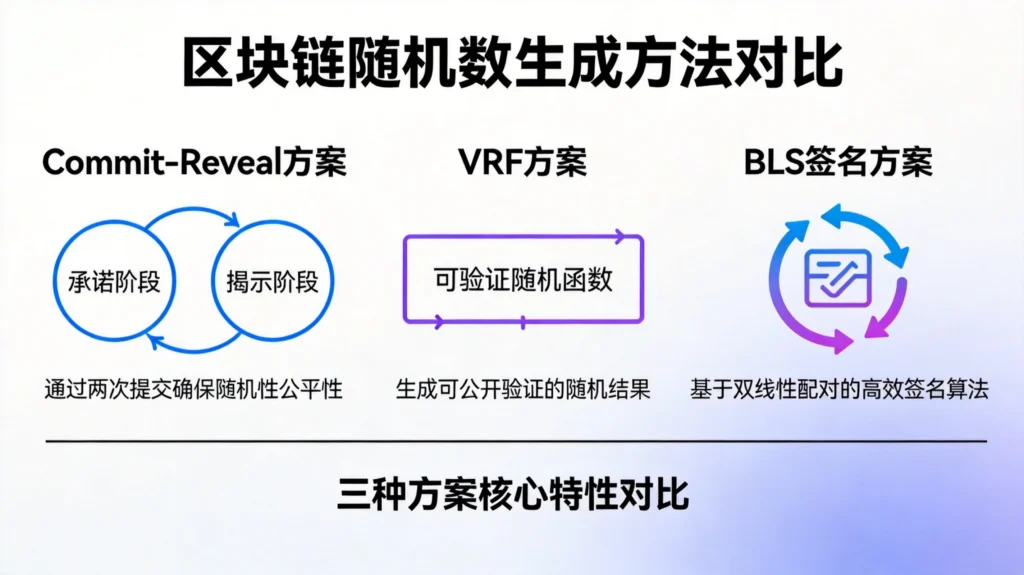
Commit-Reveal 方案
方案原理
Commit-Reveal是最经典的链上随机数生成方案,分两阶段执行:
提交阶段(Commit):用户提交一个哈希值 H(secret, nonce),这个哈希锁定了一个随机数,但在揭示之前无法被反推。
揭示阶段(Reveal):用户提交实际的secret和nonce,合约验证哈希匹配后,使用这个值作为随机源。
这个方案的关键洞察是:用户无法在提交后再修改承诺值,因为哈希已经确定。
solidity
// SPDX-License-Identifier: MIT
pragma solidity ^0.8.24;

contract CommitRevealRandom {
    // 提交记录:地址 -> 承诺哈希
    mapping(address => bytes32) public commitments;

    // 揭示记录:地址 -> 实际随机数
    mapping(address => uint256) public reveals;

    // 提交阶段的时间窗口
    uint256 public commitDeadline;
    uint256 public revealDeadline;

    // 最终随机数
    uint256 public finalRandom;
    bool public randomGenerated;

    event Committed(address indexed user, bytes32 commitment);
    event Revealed(address indexed user, uint256 randomValue);

    constructor(uint256 _commitDuration, uint256 _revealDuration) {
        commitDeadline = block.timestamp + _commitDuration;
        revealDeadline = commitDeadline + _revealDuration;
    }

    // 阶段1:提交承诺
    function commit(bytes32 commitment) external {
        require(block.timestamp < commitDeadline, "Commit phase ended");
        require(commitments[msg.sender] == bytes32(0), "Already committed");

        commitments[msg.sender] = commitment;
        emit Committed(msg.sender, commitment);
    }

    // 阶段2:揭示随机数
    function reveal(uint256 secret, uint256 nonce) external {
        require(block.timestamp >= commitDeadline, "Commit phase not ended");
        require(block.timestamp < revealDeadline, "Reveal phase ended");
        require(commitments[msg.sender] != bytes32(0), "No commitment found");

        // 验证承诺
        bytes32 computedHash = keccak256(abi.encodePacked(secret, nonce));
        require(computedHash == commitments[msg.sender], "Invalid commitment");

        // 使用secret和nonce生成个人随机数
        uint256 personalRandom = uint256(keccak256(abi.encodePacked(secret, nonce, block.timestamp)));
        reveals[msg.sender] = personalRandom;

        emit Revealed(msg.sender, personalRandom);
    }

    // 生成最终随机数:使用所有参与者揭示值的异或
    function generateFinalRandom() external {
        require(block.timestamp >= revealDeadline, "Reveal phase not ended");
        require(!randomGenerated, "Random already generated");

        uint256 seed = uint256(blockhash(block.number - 1));

        // 对所有揭示值进行异或操作
        address[] memory users = getAllUsers();
        for (uint256 i = 0; i < users.length; i++) {
            seed ^= reveals[users[i]];
        }

        finalRandom = seed;
        randomGenerated = true;
    }

    // 获取所有提交过的用户(简化版本,实际需要存储用户列表)
    function getAllUsers() internal view returns (address[] memory) {
        // 实际实现中应该维护一个用户数组
        return new address[](0);
    }

    // 使用最终随机数进行公平选择
    function fairSelect(address[] memory candidates) external view returns (address) {
        require(randomGenerated, "Random not generated");
        require(candidates.length > 0, "No candidates");

        return candidates[finalRandom % candidates.length];
    }
}
Commit-Reveal的局限性
虽然Commit-Reveal方案简单有效,但存在明显的局限性:
- 两阶段交易:用户需要提交两次交易,增加了交互复杂度
- 最后一刻攻击:在揭示阶段,矿工仍然可以选择性地打包揭示交易
- 参与率问题:如果部分用户在揭示阶段不行动(忘记或故意),方案可能失败
- 串通攻击:多个参与者可以串通,在揭示阶段协调彼此的输入
增强版本:Commit-Reveal + 区块依赖
为了提高安全性,可以将Commit-Reveal与区块属性结合:
solidity
contract EnhancedCommitReveal {
    struct Commitment {
        bytes32 hash;
        uint256 commitBlock;
        bool revealed;
        uint256 revealValue;
    }

    mapping(address => Commitment) public commitments;
    uint256 public revealPhaseEnd;
    uint256 public finalRandom;

    constructor(uint256 _revealPhaseDuration) {
        revealPhaseEnd = block.timestamp + _revealPhaseDuration;
    }

    function commit(bytes32 _commitment) external {
        require(commitments[msg.sender].hash == bytes32(0), "Already committed");

        commitments[msg.sender] = Commitment({
            hash: _commitment,
            commitBlock: block.number,
            revealed: false,
            revealValue: 0
        });
    }

    function reveal(uint256 secret, uint256 nonce) external {
        Commitment storage c = commitments[msg.sender];
        require(c.hash != bytes32(0), "No commitment");
        require(!c.revealed, "Already revealed");

        // 验证承诺
        require(
            keccak256(abi.encodePacked(secret, nonce)) == c.hash,
            "Invalid secret"
        );

        // 组合多个不可预测因素
        c.revealValue = uint256(keccak256(abi.encodePacked(
            secret,
            nonce,
            c.commitBlock,
            block.number,
            blockhash(c.commitBlock),
            blockhash(block.number - 1)
        )));
        c.revealed = true;
    }

    function generateRandom() external {
        require(block.timestamp >= revealPhaseEnd, "Phase not ended");

        uint256 seed = 0;
        address[] memory users = getCommittedUsers();

        // 使用提交者的reveal值和区块哈希
        for (uint256 i = 0; i < users.length; i++) {
            Commitment storage c = commitments[users[i]];
            if (c.revealed) {
                seed ^= c.revealValue;
            }
            // 未揭示的用户,其commitBlock也有贡献
            seed ^= c.commitBlock * 31337;
        }

        // 加入额外的区块属性
        seed ^= uint256(blockhash(block.number - 1));
        seed ^= uint256(block.coinbase);

        finalRandom = uint256(keccak256(abi.encodePacked(seed)));
    }

    function getCommittedUsers() internal view returns (address[] memory) {
        // 实际实现需要维护用户列表
        return new address[](0);
    }
}
Chainlink VRF 方案
VRF的核心原理
Chainlink Verifiable Random Function (VRF) 提供了链上可验证的随机数生成服务,是目前最广泛使用的去中心化随机数解决方案。
VRF的工作原理基于密码学:
- Chainlink节点使用私钥对输入数据(包括用户提供的种子)进行签名
- 合约通过公钥验证签名的有效性
- 签名结果经过哈希处理,转换为可用的随机数
由于节点的私钥不可见,任何人都无法预测VRF输出。合约可以在链上验证VRF证明的有效性,确保随机数的真实性。
solidity
// SPDX-License-Identifier: MIT
pragma solidity ^0.8.24;

import "@chainlink/contracts/src/v0.8/interfaces/VRFCoordinatorV2Interface.sol";
import "@chainlink/contracts/src/v0.8/VRFConsumerBaseV2.sol";

contract VRFRandomConsumer is VRFConsumerBaseV2 {
    VRFCoordinatorV2Interface public immutable vrfCoordinator;

    // Chainlink VRF配置
    uint64 public immutable subscriptionId;
    bytes32 public immutable keyHash;
    uint32 public constant callbackGasLimit = 100000;
    uint16 public constant requestConfirmations = 3;
    uint32 public constant numWords = 2;

    // 请求记录
    mapping(uint256 => address) public requestToSender;
    mapping(uint256 => uint256) public requestToSeed;

    // 随机数结果
    uint256[] public randomResults;

    // VRF请求事件
    event RandomWordsRequested(uint256 requestId, address requester);
    event RandomWordsReceived(uint256 requestId, uint256[] randomWords);

    constructor(
        address _vrfCoordinator,
        uint64 _subscriptionId,
        bytes32 _keyHash
    ) VRFConsumerBaseV2(_vrfCoordinator) {
        vrfCoordinator = VRFCoordinatorV2Interface(_vrfCoordinator);
        subscriptionId = _subscriptionId;
        keyHash = _keyHash;
    }

    // 请求随机数
    function requestRandomWords() external returns (uint256 requestId) {
        // 使用区块属性和用户地址作为种子,增加熵
        uint256 seed = uint256(
            keccak256(abi.encode(
                block.timestamp,
                block.difficulty,
                msg.sender,
                gasleft()
            ))
        );

        // 将发送者与请求ID关联,便于后续处理
        requestToSender[requestId] = msg.sender;
        requestToSeed[requestId] = seed;

        requestId = vrfCoordinator.requestRandomWords(
            keyHash,
            subscriptionId,
            requestConfirmations,
            callbackGasLimit,
            numWords
        );

        emit RandomWordsRequested(requestId, msg.sender);
    }

    // Chainlink VRF回调函数
    function fulfillRandomWords(
        uint256 requestId,
        uint256[] memory randomWords
    ) internal override {
        require(requestToSender[requestId] == msg.sender, "Wrong request");

        // 保存随机数结果
        for (uint256 i = 0; i < randomWords.length; i++) {
            randomResults.push(randomWords[i]);
        }

        emit RandomWordsReceived(requestId, randomWords);
    }

    // 使用随机数进行公平选择
    function fairSelectWithVRF(
        uint256 requestId,
        address[] memory candidates
    ) external returns (address) {
        require(candidates.length > 0, "Empty candidates");

        uint256 randomValue = randomResults[requestId % randomResults.length];
        return candidates[randomValue % candidates.length];
    }
}
订阅者ID与资金管理
在实际部署中,你需要:
- 在 Chainlink VRF Portal 上创建订阅者ID
- 为订阅者充值LINK代币(用于支付Oracle费用)
- 将消费者合约添加到订阅者
solidity
// 订阅管理器:允许合约加入VRF订阅
contract VRFSubscriptionManager {
    VRFCoordinatorV2Interface public immutable vrfCoordinator;
    uint64 public immutable subscriptionId;

    // 授权的消费者合约列表
    mapping(address => bool) public authorizedConsumers;

    event ConsumerAuthorized(address consumer);
    event ConsumerUnauthorized(address consumer);

    constructor(address _vrfCoordinator, uint64 _subscriptionId) {
        vrfCoordinator = VRFCoordinatorV2Interface(_vrfCoordinator);
        subscriptionId = _subscriptionId;
    }

    // 添加消费者合约
    function addConsumer(address consumer) external {
        authorizedConsumers[consumer] = true;
        vrfCoordinator.addConsumer(subscriptionId, consumer);
        emit ConsumerAuthorized(consumer);
    }

    // 移除消费者合约
    function removeConsumer(address consumer) external {
        authorizedConsumers[consumer] = false;
        vrfCoordinator.removeConsumer(subscriptionId, consumer);
        emit ConsumerUnauthorized(consumer);
    }
}
链下签名方案
BLS 签名聚合
一种更高级的方案是使用链下签名聚合。多个签名者对同一消息签名,其签名可以聚合为一个签名。聚合签名的哈希值可以作为高质量的随机数。
这种方案的优势:
- 完全链下计算,Gas效率高
- 可实现阈值的去中心化(需要N-of-M个签名者参与)
- 签名过程实时,延迟低
solidity
// SPDX-License-Identifier: MIT
pragma solidity ^0.8.24;

/**
 * @title BLS Signature Based Randomness
 * @notice 使用BLS签名聚合生成链上随机数
 */
contract BLSSignatureRandom {
    // 签名者集合
    address[] public signers;
    mapping(address => bool) public isSigner;

    // 每个轮次的签名收集
    struct SigningRound {
        bytes32 message;
        uint256 threshold;
        mapping(address => bytes) signatures;
        mapping(address => bool) hasSigned;
        uint256 signersCount;
        bytes32 finalRandom;
        bool completed;
    }

    mapping(uint256 => SigningRound) public rounds;
    uint256 public currentRound;

    // 模拟BLS配对验证(实际使用需要预编译或库)
    function verifySignature(
        bytes memory publicKey,
        bytes memory message,
        bytes memory signature
    ) internal pure returns (bool) {
        // 实际实现中应使用BLS12-381配对函数
        // 这里使用简化的占位实现
        return signature.length == 96;
    }

    // 发起新的签名轮次
    function startNewRound(bytes32 message) external {
        require(isSigner[msg.sender], "Not a signer");

        currentRound++;
        SigningRound storage round = rounds[currentRound];
        round.message = message;
        round.threshold = (signers.length * 2) / 3 + 1; // 2/3阈值
        round.completed = false;

        // 签名者自动参与第一轮
        submitSignature(round.message);
    }

    // 提交签名
    function submitSignature(bytes32 message) public {
        require(isSigner[msg.sender], "Not a signer");

        SigningRound storage round = rounds[currentRound];
        require(!round.hasSigned[msg.sender], "Already signed");

        // 模拟签名过程(实际需要链下签名)
        bytes memory signature = abi.encodePacked(
            keccak256(abi.encodePacked(message, msg.sender, block.timestamp))
        );

        round.signatures[msg.sender] = signature;
        round.hasSigned[msg.sender] = true;
        round.signersCount++;

        // 检查是否达到阈值
        if (round.signersCount >= round.threshold) {
            finalizeRound();
        }
    }

    // 完成轮次,生成最终随机数
    function finalizeRound() internal {
        SigningRound storage round = rounds[currentRound];
        require(!round.completed, "Already completed");

        // 聚合所有签名
        bytes32 aggregatedSignature = bytes32(0);

        for (uint256 i = 0; i < signers.length; i++) {
            address signer = signers[i];
            if (round.hasSigned[signer]) {
                aggregatedSignature ^= bytes32(round.signatures[signer]);
            }
        }

        // 生成最终随机数
        round.finalRandom = uint256(keccak256(abi.encodePacked(
            round.message,
            aggregatedSignature,
            blockhash(block.number - 1)
        )));
        round.completed = true;
    }

    // 获取当前轮次的随机数
    function getCurrentRandom() external view returns (uint256) {
        return rounds[currentRound].finalRandom;
    }

    // 管理签名者
    function addSigner(address signer) external {
        require(!isSigner[signer], "Already a signer");
        signers.push(signer);
        isSigner[signer] = true;
    }

    function removeSigner(address signer) external {
        require(isSigner[signer], "Not a signer");
        isSigner[signer] = false;
    }
}
RANDAO + VDF 方案
RANDAO的原理
RANDAO是一种简单的链上随机数协议:多个参与者各自提交随机数,所有随机数被汇总(通常通过异或运算)生成最终随机数。
solidity
// SPDX-License-Identifier: MIT
pragma solidity ^0.8.24;

contract RandaoRandom {
    // 参与者的承诺
    mapping(address => bytes32) public commitments;

    // 揭示阶段
    mapping(address => uint256) public reveals;

    // RANDAO参数
    uint256 public constant REVEAL_PERIOD = 50; // 区块数
    uint256 public commitmentCount;
    uint256 public revealCount;
    uint256 public finalRandom;
    bool public randomLocked;

    uint256 public commitEndBlock;
    uint256 public revealEndBlock;

    event CommitmentMade(address indexed participant, bytes32 commitment);
    event RevealMade(address indexed participant, uint256 revealedValue);
    event RandomGenerated(uint256 finalValue);

    constructor() {
        commitEndBlock = block.number + REVEAL_PERIOD;
        revealEndBlock = commitEndBlock + REVEAL_PERIOD;
    }

    // 阶段1:提交承诺
    function commit(bytes32 commitment) external {
        require(block.number < commitEndBlock, "Commit period ended");
        require(commitments[msg.sender] == bytes32(0), "Already committed");

        commitments[msg.sender] = commitment;
        commitmentCount++;

        emit CommitmentMade(msg.sender, commitment);
    }

    // 阶段2:揭示
    function reveal(uint256 secret) external {
        require(block.number >= commitEndBlock, "Commit period not ended");
        require(block.number < revealEndBlock, "Reveal period ended");
        require(commitments[msg.sender] != bytes32(0), "No commitment");
        require(reveals[msg.sender] == 0, "Already revealed");

        // 验证承诺
        bytes32 computedHash = keccak256(abi.encodePacked(secret, msg.sender));
        require(computedHash == commitments[msg.sender], "Invalid secret");

        reveals[msg.sender] = secret;
        revealCount++;

        emit RevealMade(msg.sender, secret);
    }

    // 生成最终随机数
    function finalize() external {
        require(block.number >= revealEndBlock, "Reveal period not ended");
        require(!randomLocked, "Already finalized");

        uint256 seed = uint256(blockhash(block.number - 1));

        // 异或所有揭示值
        address[] memory participants = getParticipants();
        for (uint256 i = 0; i < participants.length; i++) {
            if (reveals[participants[i]] != 0) {
                seed ^= reveals[participants[i]];
            }
        }

        finalRandom = uint256(keccak256(abi.encodePacked(seed)));
        randomLocked = true;

        emit RandomGenerated(finalRandom);
    }

    // 获取所有参与者
    function getParticipants() internal view returns (address[] memory) {
        // 实际实现需要维护参与者列表
        return new address[](0);
    }
}
RANDAO的局限性
- 最后揭示者攻击:最后一个揭示者可以看到所有其他值,选择性揭示以影响结果
- 不揭示惩罚:参与者可以不揭示,破坏随机数生成
RANDAO + VDF 增强
VDF(Verifiable Delay Function)可以解决最后揭示者攻击。VDF需要一定的计算时间才能得出结果,这个时间窗口使得任何人(包括最后一个揭示者)都无法在结果出来后反向操控。
实用场景:NFT随机属性分配
让我们通过一个实际案例来展示随机数的应用——NFT的属性随机分配:
solidity
// SPDX-License-Identifier: MIT
pragma solidity ^0.8.24;

import "@chainlink/contracts/src/v0.8/VRFConsumerBaseV2.sol";

contract RandomNFTAttributes is VRFConsumerBaseV2 {
    // 属性定义
    enum Rarity { Common, Uncommon, Rare, Epic, Legendary }

    struct AttributeSet {
        Rarity rarity;
        uint256 power;
        uint256 speed;
        uint256 intelligence;
    }

    // NFT属性
    mapping(uint256 => AttributeSet) public tokenAttributes;

    // VRF配置
    uint64 public subscriptionId;
    bytes32 public keyHash;

    // 请求映射
    mapping(uint256 => uint256) public requestToTokenId;
    mapping(uint256 => uint256) public requestToVRFRequestId;

    // Rarity概率(百分比 x 100)
    uint256[] public rarityChances = [
        5000,  // Common: 50%
        3000,  // Uncommon: 30%
        1500,  // Rare: 15%
        400,   // Epic: 4%
        100    // Legendary: 1%
    ];

    constructor(
        address vrfCoordinator,
        uint64 _subscriptionId,
        bytes32 _keyHash
    ) VRFConsumerBaseV2(vrfCoordinator) {
        subscriptionId = _subscriptionId;
        keyHash = _keyHash;
    }

    function mintWithRandomAttributes(address to) external returns (uint256 tokenId) {
        tokenId = totalSupply++; // 简化实现

        // 请求VRF随机数
        uint256 vrfRequestId = vrfCoordinator.requestRandomWords(
            keyHash,
            subscriptionId,
            3,  // requestConfirmations
            100000,  // callbackGasLimit
            1        // numWords
        );

        requestToTokenId[vrfRequestId] = tokenId;

        return tokenId;
    }

    function fulfillRandomWords(
        uint256 requestId,
        uint256[] memory randomWords
    ) internal override {
        uint256 tokenId = requestToTokenId[requestId];
        uint256 random = randomWords[0];

        // 根据随机数决定稀有度
        Rarity rarity = determineRarity(random);

        // 根据稀有度决定属性范围
        tokenAttributes[tokenId] = AttributeSet({
            rarity: rarity,
            power: generateAttribute(random, getMinPower(rarity), getMaxPower(rarity)),
            speed: generateAttribute(random + 1, getMinSpeed(rarity), getMaxSpeed(rarity)),
            intelligence: generateAttribute(random + 2, getMinInt(rarity), getMaxInt(rarity))
        });
    }

    function determineRarity(uint256 random) internal view returns (Rarity) {
        uint256 roll = random % 10000;
        uint256 cumulative = 0;

        for (uint256 i = 0; i < rarityChances.length; i++) {
            cumulative += rarityChances[i];
            if (roll < cumulative) {
                return Rarity(i);
            }
        }

        return Rarity.Common;
    }

    function generateAttribute(
        uint256 seed,
        uint256 min,
        uint256 max
    ) internal pure returns (uint256) {
        return min + (seed % (max - min + 1));
    }

    // 稀有度属性范围
    function getMinPower(Rarity r) internal pure returns (uint256) {
        if (r == Rarity.Common) return 10;
        if (r == Rarity.Uncommon) return 30;
        if (r == Rarity.Rare) return 50;
        if (r == Rarity.Epic) return 70;
        return 90;
    }

    function getMaxPower(Rarity r) internal pure returns (uint256) {
        if (r == Rarity.Common) return 29;
        if (r == Rarity.Uncommon) return 49;
        if (r == Rarity.Rare) return 69;
        if (r == Rarity.Epic) return 89;
        return 100;
    }

    // 类似方法用于 speed 和 intelligence

    function getMinSpeed(Rarity r) internal pure returns (uint256) {
        if (r == Rarity.Common) return 5;
        if (r == Rarity.Uncommon) return 20;
        if (r == Rarity.Rare) return 40;
        if (r == Rarity.Epic) return 60;
        return 80;
    }

    function getMaxSpeed(Rarity r) internal pure returns (uint256) {
        if (r == Rarity.Common) return 19;
        if (r == Rarity.Uncommon) return 39;
        if (r == Rarity.Rare) return 59;
        if (r == Rarity.Epic) return 79;
        return 100;
    }

    function getMinInt(Rarity r) internal pure returns (uint256) {
        if (r == Rarity.Common) return 1;
        if (r == Rarity.Uncommon) return 15;
        if (r == Rarity.Rare) return 35;
        if (r == Rarity.Epic) return 55;
        return 75;
    }

    function getMaxInt(Rarity r) internal pure returns (uint256) {
        if (r == Rarity.Common) return 14;
        if (r == Rarity.Uncommon) return 34;
        if (r == Rarity.Rare) return 54;
        if (r == Rarity.Epic) return 74;
        return 100;
    }
}
方案选型指南
| 方案 | 安全性 | 成本 | 去中心化程度 | 适用场景 |
|---|---|---|---|---|
| Block Hash | 低 | 极低 | 依赖区块提议者 | 实验/内部工具 |
| Commit-Reveal | 中 | 低 | 无需信任 | 小规模应用 |
| Chainlink VRF | 高 | 中 | 完全去中心化 | 生产环境首选 |
| BLS聚合签名 | 高 | 低 | 取决于签名者 | 高频随机需求 |
| RANDAO | 中高 | 低 | 无需信任 | 协议内生随机 |
总结
区块链随机数生成是一个需要根据具体场景权衡的问题。对于大多数生产级应用,Chainlink VRF是当前最可靠的选择,兼顾了安全性、去中心化和开发便利性。
如果你的项目有特殊需求:
- 成本敏感:Commit-Reveal或RANDAO是更低Gas的替代方案
- 极高频率:考虑链下BLS签名聚合方案
- 组合使用:常见做法是VRF作为主随机源,同时在最终计算中加入区块哈希等链上因素作为额外熵
无论如何,请记住一个核心原则:永远不要单独使用区块哈希或时间戳作为唯一随机源。
相关阅读:
发表回复