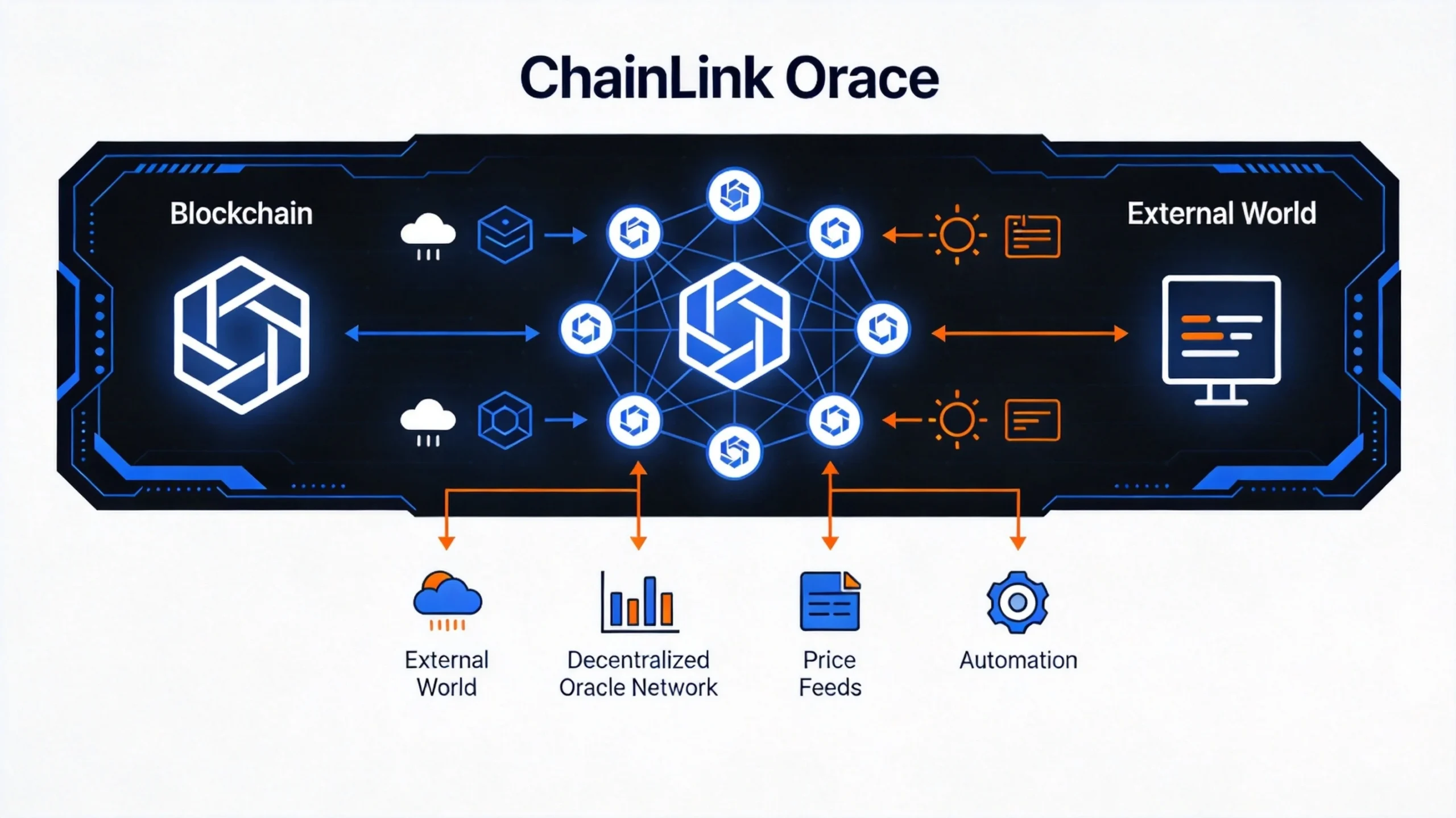
为什么需要去中心化预言机
你可能会问:中心化数据源不行吗?比如直接在合约里调用一个API获取价格。
不行。原因是:如果数据源是中心化的,整个系统的安全性就取决于那个单点。想象你写了一个用某个交易所价格进行清算的合约,如果那个交易所宕机或者数据被篡改,你的合约就会出问题。更糟糕的是,链上无法验证这个数据是否被篡改。
去中心化预言机通过多重机制解决这个风险:多个独立的数据源、多个独立的预言机节点、聚合算法处理数据。这让数据既难以被操控,又能保持高可用性。
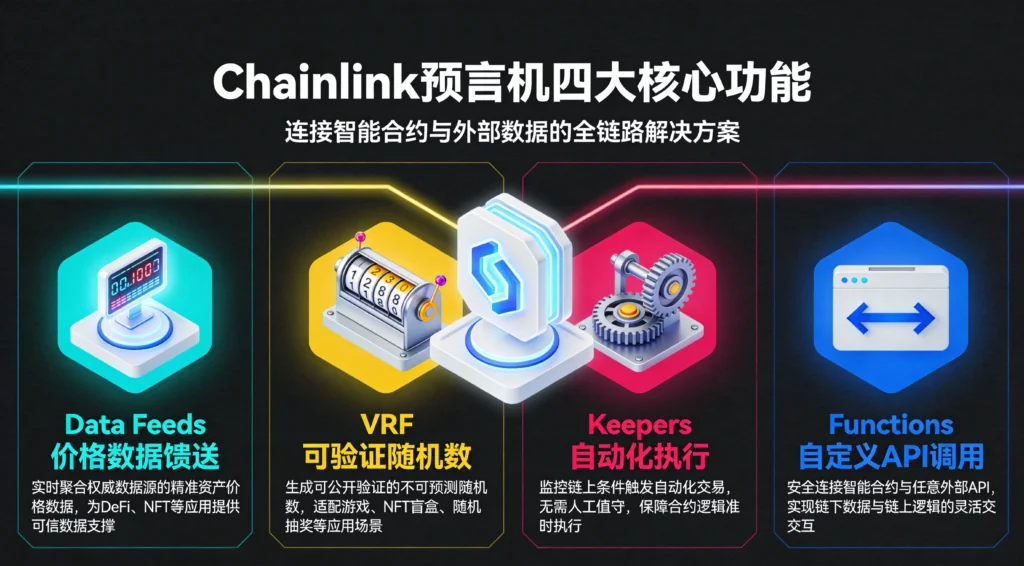
Chainlink Data Feeds:获取价格数据
这是Chainlink最常用的功能——为合约提供资产价格数据。Uniswap、Aave等主流DeFi协议都用它。
工作原理
Chainlink维护着一组价格对(如ETH/USD),每个价格由多个数据源聚合而来,经过去中心化预言机网络传输,最终存储在链上合约中。数据定期更新(通常每分钟或更快)。
集成步骤
第一步:找到对应的Feed地址
每个链的Data Feed地址不同。以太坊主网的ETH/USD地址是:
plaintext
0x5f4eC3Df9cbd43714FE2740f5E3616185c4D31f7
其他链和交易对的地址可以在Chainlink文档中找到。
第二步:编写合约代码
solidity
// SPDX-License-Identifier: MIT
pragma solidity ^0.8.24;

import "@chainlink/contracts/src/v0.8/interfaces/AggregatorV3Interface.sol";

contract PriceConsumer {
    AggregatorV3Interface internal priceFeed;

    constructor() {
        // 初始化ETH/USD价格feed
        priceFeed = AggregatorV3Interface(
            0x5f4eC3Df9cbd43714FE2740f5E3616185c4D31f7
        );
    }

    /**
     * 获取最新价格
     * 返回 (roundId, price, startedAt, updatedAt, answeredInRound)
     */
    function getLatestPrice() public view returns (int256) {
        (
            /* uint80 roundId */,
            int256 price,
            /* uint256 startedAt */,
            /* uint256 updatedAt */,
            /* uint80 answeredInRound */
        ) = priceFeed.latestRoundData();
        return price;
    }

    /**
     * 获取指定轮次的价格
     */
    function getHistoricalPrice(uint80 roundId) public view returns (int256) {
        (
            uint80 id,
            int256 price,
            uint256 startedAt,
            uint256 updatedAt,
            uint80 answeredInRound
        ) = priceFeed.getRoundData(roundId);

        require(answeredInRound >= roundId, "Stale data");
        require(updatedAt > 0, "Round not complete");

        return price;
    }
}
第三步:理解返回数据
latestRoundData()返回的结构需要特别注意:
- price:价格,精度通常是8位小数。ETH/USD可能返回类似
351200000000(3512.00美元) - updatedAt:数据更新时间戳
- answeredInRound:确认轮次
使用价格数据时,务必检查数据是否过期:
solidity
function getLatestPriceWithValidation() public view returns (int256) {
    (
        uint80 roundId,
        int256 price,
        uint256 startedAt,
        uint256 updatedAt,
        uint80 answeredInRound
    ) = priceFeed.latestRoundData();

    // 检查数据有效性
    require(price > 0, "Invalid price");
    require(answeredInRound >= roundId, "Stale data");

    // 检查数据是否太旧(超过3分钟)
    uint256 maxAge = 3 minutes;
    require(block.timestamp - updatedAt <= maxAge, "Price too old");

    return price;
}
Chainlink VRF:生成可验证随机数
区块链上没有真正的随机数,因为所有节点必须能验证相同的结果。Chainlink VRF通过密码学证明解决了这个问题——随机数可以被链上验证是真随机,而不是被预言机节点操控的。
请求随机数的模式
VRF采用”请求-响应”模式:
- 合约发起随机数请求(需要支付LINK代币)
- 预言机生成随机数并附上证明
- 链上验证证明有效后,随机数才可用
完整实现示例
solidity
// SPDX-License-Identifier: MIT
pragma solidity ^0.8.24;

import "@chainlink/contracts/src/v0.8/VRFV2WrapperConsumerBase.sol";

contract RandomNFT is VRFV2WrapperConsumerBase {
    uint256 public constant REQUEST_CONFIRMATIONS = 3;
    uint256 public constant NUM_WORDS = 1;
    uint256 public constant.callbackGasLimit = 100000;

    // 请求ID到请求信息的映射
    mapping(uint256 => address) public requestIdToSender;
    mapping(uint256 => uint256) public requestIdToSeed;

    // NFT属性配置
    uint256[] public rarityRanges = [70, 90, 98, 100];  // 普通70%, 稀有20%, 史诗7%, 传说3%

    constructor()
        VRFV2WrapperConsumerBase(
            0x271682DEB8C4E2001eb050A2AFb27Cf6a2A21D6d,  // VRF Coordinator
            0x326C977E6efc84E512bB9C30f76E30c160eD06FB   // LINK Token
        )
    {}

    /**
     * 请求随机数来铸造NFT
     */
    function requestMint() external returns (uint256 requestId) {
        requestId = requestRandomWords(
            REQUEST_CONFIRMATIONS,
            callbackGasLimit,
            NUM_WORDS
        );

        requestIdToSender[requestId] = msg.sender;
    }

    /**
     * VRF回调函数 - 接收随机数
     */
    function fulfillRandomWords(
        uint256 requestId,
        uint256[] memory randomWords
    ) internal override {
        uint256 randomValue = randomWords[0];

        // 根据随机数决定NFT稀有度
        uint256 rarity = determineRarity(randomValue);

        // 调用mint函数,传入稀有度
        mintNFT(requestIdToSender[requestId], rarity);
    }

    function determineRarity(uint256 random) public pure returns (uint256) {
        uint256 n = random % 100;

        if (n < rarityRanges[0]) return 0;  // 普通
        if (n < rarityRanges[1]) return 1;  // 稀有
        if (n < rarityRanges[2]) return 2;  // 史诗
        return 3;  // 传说
    }

    function mintNFT(address to, uint256 rarity) internal {
        // mint逻辑
    }
}
关键点解析
REQUEST_CONFIRMATIONS:区块确认数,越多越安全但越慢。通常3-5个区块足够。
callbackGasLimit:处理回调函数需要的Gas上限。如果你的回调逻辑复杂,需要设置足够高的值,否则请求会失败。
请求费用估算:
solidity
function getRequestFee() public view returns (uint256) {
    return VRF_V2_WRAPPER.requestSubscription()
        ? VRF_V2_WRAPPER.calculateRequestPrice(callbackGasLimit)
        : 0;
}
实际使用中,建议先用测试网(Sepolia)测试费用,再部署到主网。
Chainlink Keepers:自动化执行
很多合约逻辑需要定期执行,比如清算、奖励分发等。Keepers替代了传统的定时任务方案,让合约可以在指定条件下自动触发。
Keeper兼容合约的要求
合约必须实现AutomationCompatibleInterface接口,提供两个关键函数:
checkUpkeep:检查是否需要执行performUpkeep:执行具体逻辑
实现自动债仓清算
solidity
// SPDX-License-Identifier: MIT
pragma solidity ^0.8.24;

import "@chainlink/contracts/src/v0.8/automation/AutomationCompatibleInterface.sol";

contract AutomatedLiquidation is AutomationCompatibleInterface {
    // 债仓信息
    struct Vault {
        address owner;
        uint256 collateral;
        uint256 debt;
    }

    mapping(uint256 => Vault) public vaults;
    mapping(address => uint256[]) public ownerVaults;

    // liquidation threshold: 健康系数低于此值会被清算
    uint256 public constant HEALTH_FACTOR_THRESHOLD = 1e18;

    // Chainlink注册时使用的 upkeepName
    function checkUpkeep(
        bytes calldata /* checkData */
    ) external override returns (bool upkeepNeeded, bytes memory performData) {
        // 检查是否有需要清算的债仓
        uint256[] memory toLiquidate = new uint256[](0);
        uint256 count = 0;

        for (uint256 i = 1; i <= vaultCount; i++) {
            if (needsLiquidation(vaults[i])) {
                count++;
            }
        }

        if (count > 0) {
            // 收集需要清算的债仓ID
            toLiquidate = new uint256[](count);
            uint256 index = 0;
            for (uint256 i = 1; i <= vaultCount; i++) {
                if (needsLiquidation(vaults[i])) {
                    toLiquidate[index++] = i;
                }
            }
            upkeepNeeded = true;
            performData = abi.encode(toLiquidate);
        }
    }

    function performUpkeep(bytes calldata performData) external override {
        uint256[] memory toLiquidate = abi.decode(performData, (uint256[]));

        for (uint256 i = 0; i < toLiquidate.length; i++) {
            liquidateVault(toLiquidate[i]);
        }
    }

    function needsLiquidation(Vault memory vault) internal view returns (bool) {
        if (vault.collateral == 0) return false;

        // 获取当前ETH价格
        int256 price = getEthPrice();
        uint256 healthFactor = calculateHealthFactor(vault, price);

        return healthFactor < HEALTH_FACTOR_THRESHOLD;
    }

    function liquidateVault(uint256 vaultId) internal {
        Vault storage vault = vaults[vaultId];

        // 执行清算逻辑
        // 1. 计算清算收益
        // 2. 从Vault转出抵押品
        // 3. 销毁债务
        // 4. 触发事件

        emit VaultLiquidated(vaultId, vault.owner, vault.collateral);
    }
}
注册Keeper Upkeep
部署合约后,需要在Chainlink自动化注册页面注册你的合约:
- 访问 app.chain.link/automation
- 连接钱包
- 选择”Custom logic”
- 填写合约地址
- 设置触发条件(时间或Gas)
- 质押LINK作为支付
API Calls:自定义数据请求
当Data Feeds和VRF都不满足需求时,Chainlink Functions(原External Adapters)允许你请求任意外部数据。
solidity
// SPDX-License-Identifier: MIT
pragma solidity ^0.8.24;

import "@chainlink/contracts/src/v0.8/functions/FunctionsClient.sol";
import "@chainlink/contracts/src/v0.8/functions/ConfirmedRequest.sol";

contract SportsDataConsumer is FunctionsClient, ConfirmedRequest {
    using Functions for Functions.Request;

    // 比赛结果结构
    struct GameResult {
        string homeTeam;
        string awayTeam;
        uint8 homeScore;
        uint8 awayScore;
        string status;
    }

    mapping(bytes32 => GameResult) public requestResults;
    mapping(bytes32 => address) public requesters;

    // Chainlink Functions路由地址(不同链不同)
    constructor(address router) FunctionsClient(router) {}

    function requestGameResult(
        string memory apiUrl,
        string memory gameId
    ) external returns (bytes32 requestId) {
        // 构建请求
        Functions.Request memory req;
        req.initializeRequest(
            Functions.Location.Inline,
            Functions.CodeLanguage.JavaScript,
            _getSource(gameId)
        );

        // 添加Secrets(如果API需要认证)
        // req.addSecretsReference(_secretsLocation);

        // 添加回调参数
        req.addArgs(abi.encode(gameId));

        // 发送请求
        requestId = sendRequest(
            req,
            subscriptionId,
            gasLimit,
            bytes(functionsBillingRegistryProxy)
        );

        requesters[requestId] = msg.sender;
    }

    function fulfillRequest(
        bytes32 requestId,
        bytes memory response,
        bytes memory /* err */
    ) internal override {
        // 解析返回数据
        GameResult memory result = abi.decode(response, (GameResult));
        requestResults[requestId] = result;

        emit RequestFulfilled(requestId, result);
    }

    function _getSource(string memory gameId) internal pure returns (string memory) {
        return string(
            abi.encodePacked(
                "const gameId = args[0];",
                "const response = await fetch(`",
                apiUrl,
                "/games/${gameId}`);",
                "const data = await response.json();",
                "return Functions.encodeJSON(data);"
            )
        );
    }
}
使用Functions需要:
- 订阅Chainlink Functions服务
- 充值LINK用于支付费用
- 管理订阅或使用per-request付费
生产环境最佳实践
价格数据使用
防御性编程:永远不要假设数据是新鲜的:
solidity
function safeGetPrice() internal view returns (int256) {
    (, int256 price, , uint256 updatedAt, ) = priceFeed.latestRoundData();

    // 时间容错
    if (block.timestamp - updatedAt > 5 minutes) {
        // 价格太旧,触发告警或使用fallback
        revert("Stale price data");
    }

    return price;
}
多头数据源:对关键操作,可以结合多个价格源取中位数:
solidity
int256[] memory prices = new int256[](3);
prices[0] = getPriceFromFeed(feed1);
prices[1] = getPriceFromFeed(feed2);
prices[2] = getPriceFromFeed(feed3);

return median(prices);
VRF费用控制
使用订阅模式统一管理费用:
- 创建订阅并充值LINK
- 将消费者合约添加到订阅
- 通过订阅支付费用,更灵活控制成本
Keepergas优化
checkUpkeep应该尽可能轻量,只做检查:
solidity
function checkUpkeep(bytes calldata) external returns (bool, bytes memory) {
    // 避免链上循环遍历
    // 只检查状态变量,不做复杂计算

    return (needsExecution, "");
}
复杂逻辑放到performUpkeep中,因为只有实际执行时才消耗Gas。
总结
Chainlink是区块链连接现实世界的重要基础设施。Data Feeds提供了可靠的价格数据,VRF解决了链上随机数问题,Keepers实现了合约自动化,Functions则支持自定义数据请求。
集成这些服务时,记住几个原则:永远验证数据新鲜度,使用防御性编程,处理各种异常情况。先在测试网充分验证,再部署到主网。Chainlink的服务虽然强大,但正确使用才能发挥其价值。
发表回复