一、智能合约安全态势概述
1.1 2025年安全事件回顾
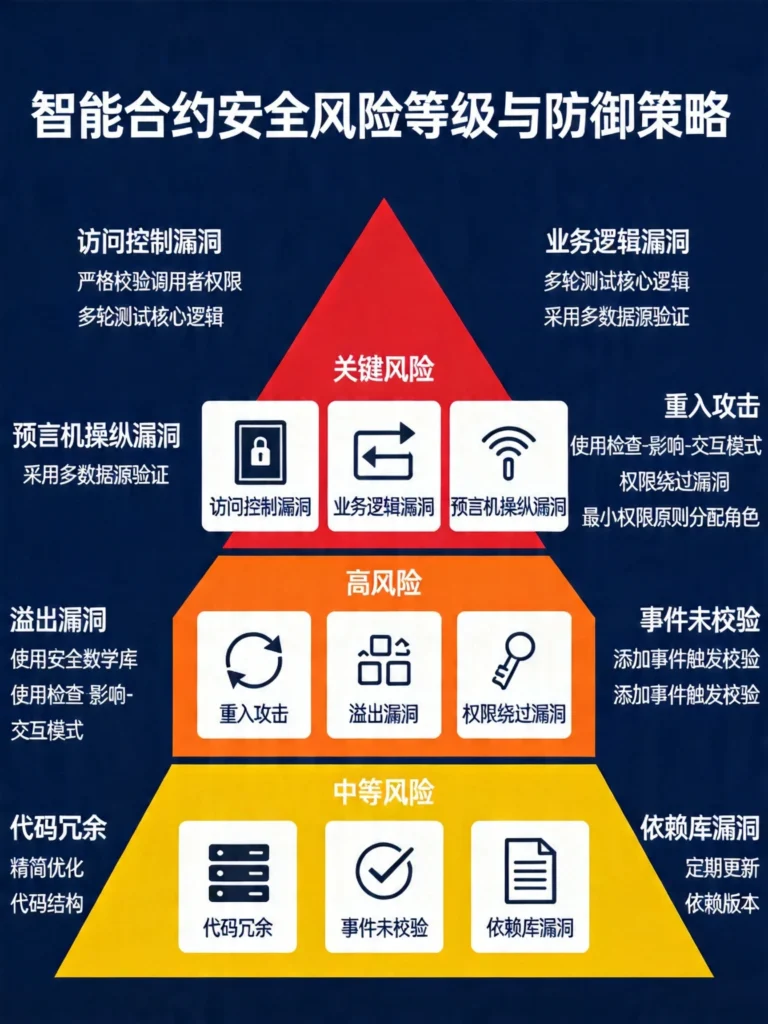
过去一年,智能合约安全领域经历了严峻考验。据不完全统计,2025年因合约漏洞导致的资金损失超过15亿美元。其中,访问控制漏洞、业务逻辑漏洞和价格预言机操纵成为三大主要威胁源。
笔者在参与多个项目审计的过程中发现,许多安全问题的根源并非开发者技术不足,而是对业务边界的理解不够深入,或是低估了攻击者的创造力。
1.2 十大风险概览
| 排名 | 风险编号 | 风险名称 | 风险等级 |
|---|---|---|---|
| 1 | SC01 | 访问控制漏洞 | 极高 |
| 2 | SC02 | 业务逻辑漏洞 | 极高 |
| 3 | SC03 | 价格预言机操纵 | 极高 |
| 4 | SC04 | 闪电贷辅助攻击 | 高 |
| 5 | SC05 | 输入验证不足 | 高 |
| 6 | SC06 | 未检查的外部调用 | 高 |
| 7 | SC07 | 算术错误 | 中高 |
| 8 | SC08 | 重入攻击 | 中高 |
| 9 | SC09 | 整数溢出/下溢 | 中 |
| 10 | SC10 | 代理与可升级性漏洞 | 中 |
二、SC01访问控制漏洞:最致命的权限后门
2.1 漏洞根源分析
访问控制漏洞的产生通常源于以下几种情况:
权限检查缺失或绕过:开发者可能忘记在关键函数前添加权限校验,或校验逻辑存在绕过路径。
solidity
// 错误示例:权限检查可被绕过
contract VulnerableProtocol {
    address public admin;

    function setFee(uint256 newFee) external {
        // 看似检查了调用者身份
        require(msg.sender == admin);
        fee = newFee;
    }

    function emergencyWithdraw() external {
        // 严重问题:没有任何权限检查!
        (bool success, ) = msg.sender.call{value: address(this).balance}("");
        require(success);
    }
}
onlyOwner滥用:过度依赖单一管理员账户,未实现多签或时间锁机制。
角色权限未隔离:将不同权限级别混用,导致低权限账户可能执行高权限操作。
2.2 实战案例分析
2026年2月的Ploutos Money事件就是典型案例。攻击者利用Oracle配置错误(实际是预谋的Rugpull),在单笔交易中窃取了约39万美元。官方在漏洞利用发生前一个区块才完成配置修改,这种时间窗口的巧合让安全研究者怀疑存在内部协作。
2.3 防御策略
solidity
// SPDX-License-Identifier: MIT
pragma solidity ^0.8.26;

contract SecureAccessControl {
    // 使用角色进行权限隔离
    bytes32 public constant ADMIN_ROLE = keccak256("ADMIN_ROLE");
    bytes32 public constant OPERATOR_ROLE = keccak256("OPERATOR_ROLE");

    // 建议使用OpenZeppelin的AccessControl
    using AccessControl for AccessControl.RolesStorage;
    AccessControl.RolesStorage private _roles;

    // 多重签名验证
    mapping(bytes32 => mapping(address => bool)) private _roleMembers;
    mapping(bytes32 => uint256) private _requiredConfirmations;

    modifier onlyRole(bytes32 role) {
        require(hasRole(role, msg.sender), "Access denied");
        _;
    }

    // 带时间锁的升级机制
    uint256 public constant TIMELOCK_DELAY = 2 days;
    mapping(bytes32 => uint256) private _pendingActions;

    function scheduleRoleChange(
        bytes32 role,
        address account,
        bool granted
    ) external onlyRole(ADMIN_ROLE) {
        bytes32 actionHash = keccak256(abi.encode(role, account, granted));
        _pendingActions[actionHash] = block.timestamp + TIMELOCK_DELAY;
    }

    function executeRoleChange(
        bytes32 role,
        address account,
        bool granted
    ) external onlyRole(ADMIN_ROLE) {
        bytes32 actionHash = keccak256(abi.encode(role, account, granted));
        require(
            _pendingActions[actionHash] > 0 &&
            block.timestamp >= _pendingActions[actionHash],
            "Timelock not expired"
        );

        if (granted) {
            _roles.grantRole(role, account);
        } else {
            _roles.revokeRole(role, account);
        }

        delete _pendingActions[actionHash];
    }
}
三、SC02业务逻辑漏洞
四、SC03价格预言机操纵:高频爆发的财富收割机
4.1 攻击原理
价格预言机操纵是DeFi领域最常见的攻击向量。攻击者通过操控DEX池的价格或利用预言机的时间窗口,使合约获取错误的价格数据,从而实现超额借贷或套利。
关键问题在于:大多数合约使用当前价格而非时间加权平均价格(TWAP),这给了攻击者短时间操控价格的机会。
4.2 典型攻击模式
solidity
// 漏洞合约:使用单一数据源的预言机
contract VulnerableLending {
    AggregatorV3Interface public priceFeed;

    function getCollateralValue(address token) public view returns (uint256) {
        // 问题:直接使用Chainlink当前价格
        (, int256 price, , , ) = priceFeed.latestRoundData();
        return (collateralAmount * uint256(price)) / 1e8;
    }

    function liquidate(address borrower) external {
        uint256 healthFactor = calculateHealthFactor(borrower);
        require(healthFactor < 1e18, "Not liquidatable");

        // 攻击者可以在清算前操控预言机
        // 使healthFactor刚好超过阈值,阻止正常清算
    }
}
4.3 防御方案
使用TWAP而非即时价格:
solidity
contract SecureLending {
    // Uniswap V3 TWAP预言机
    IUniswapV3Pool public pool;
    uint32 public twapInterval = 30 minutes;

    function getTWAPPrice() public view returns (uint256) {
        (uint256[] memory prices, ) = getQuotierQuote(
            pool,
            1e18,
            twapInterval
        );

        uint256累计价格 = 0;
        for (uint256 i = 0; i < prices.length; i++) {
            累计价格 += prices[i];
        }
        return 累计价格 / prices.length;
    }

    // 多数据源聚合
    using Chainlink for Chainlink.Feed;
    Chainlink.Feed[] public priceFeeds;

    function getAggregatedPrice() public view returns (uint256) {
        uint256[] memory prices = new uint256[](priceFeeds.length);

        for (uint256 i = 0; i < priceFeeds.length; i++) {
            prices[i] = priceFeeds[i].latestAnswer();
        }

        // 使用中位数而非平均值
        return _median(prices);
    }

    function _median(uint256[] memory arr) internal pure returns (uint256) {
        // 排序后取中间值
        sort(arr);
        if (arr.length % 2 == 0) {
            return (arr[arr.length/2-1] + arr[arr.length/2]) / 2;
        } else {
            return arr[arr.length/2];
        }
    }
}
五、SC08重入攻击:历史教训与技术演进
5.1 DAO事件的警示
2016年The DAO事件至今仍是智能合约安全教育的经典案例。攻击者利用重入漏洞窃取了360万ETH(当时价值约5000万美元)。这一事件直接导致了以太坊的硬分叉,也催生了现代智能合约安全开发范式。
5.2 现代防护机制
solidity
contract ModernReentrancyProtection {
    // 方式一:ReentrancyGuard
    uint256 private constant _NOT_ENTERED = 1;
    uint256 private constant _ENTERED = 2;
    uint256 private transient _status; // 使用Transient Storage更优

    modifier nonReentrant() {
        require(_status != _ENTERED, "Reentrancy: reentrant call");
        _status = _ENTERED;
        _;
        _status = _NOT_ENTERED;
    }

    // 方式二:检查-生效-交互模式
    function safeTransfer(
        address to,
        uint256 amount,
        bytes memory data
    ) internal virtual {
        // 检查
        require(balanceOf(msg.sender) >= amount, "Insufficient balance");

        // 生效(先更新状态)
        _updateBalance(msg.sender, balanceOf(msg.sender) - amount);
        _updateBalance(to, balanceOf(to) + amount);

        // 交互(状态已更新,不再受重入影响)
        emit Transfer(msg.sender, to, amount);
    }

    // 方式三:限定调用者白名单
    mapping(address => bool) public verifiedContracts;

    modifier onlyVerifiedContract() {
        require(
            msg.sender == tx.origin || verifiedContracts[msg.sender],
            "Caller not verified"
        );
        _;
    }
}
六、SC09整数溢出与下溢
6.1 Solidity 0.8+的防护
Solidity 0.8之前的版本需要使用SafeMath库来防护整数溢出:
solidity
// Solidity 0.7及之前的写法
pragma solidity ^0.7.0;

library SafeMath {
    function add(uint256 a, uint256 b) internal pure returns (uint256) {
        uint256 c = a + b;
        require(c >= a, "Overflow");
        return c;
    }

    function sub(uint256 a, uint256 b) internal pure returns (uint256) {
        require(b <= a, "Underflow");
        return a - b;
    }
}
Solidity 0.8+内置溢出保护:
solidity
// Solidity 0.8+的写法
pragma solidity ^0.8.26;

contract SafeArithmetic {
    function add(uint256 a, uint256 b) external pure returns (uint256) {
        // 自动溢出检查,失败则revert
        return a + b;
    }

    // 特殊情况使用unchecked
    function efficientLoop(uint256 n) external pure returns (uint256 sum) {
        // 在确定不会溢出的场景使用unchecked节省Gas
        unchecked {
            for (uint256 i = 0; i < n; i++) {
                sum += i; // sum溢出不可能发生因为上限由n控制
            }
        }
    }
}
七、综合安全检查清单
| 检查项 | 优先级 | 说明 |
|---|---|---|
| 权限控制审计 | 极高 | 验证所有特权函数的访问控制 |
| 业务逻辑验证 | 极高 | 完整测试边界条件和极端场景 |
| 预言机安全 | 极高 | 使用TWAP和多数据源聚合 |
| 重入防护 | 高 | 使用ReentrancyGuard或CEI模式 |
| 输入验证 | 高 | 验证所有外部输入 |
| 算术运算 | 中高 | 关注小数精度和舍入处理 |
| 升级机制 | 中 | 确保时间锁和多签配置 |
八、结语
智能合约安全不是一次性任务,而是持续的过程。随着EVM功能的演进和攻击手段的升级,防御策略也需要不断迭代。开发者应当:
- 深入理解每个特性的安全边界
- 建立完善的测试和审计流程
- 关注行业安全动态和最新漏洞披露
- 在代码质量和开发速度之间找到平衡
记住:合约一旦部署,其安全性就取决于代码本身。任何疏漏都可能成为攻击者的突破口。
常见问题
Q: 如何选择合适的安全审计机构?
A: 应选择具有良好声誉、公开审计历史和漏洞披露机制的专业机构。重点考察其审计过类似项目的经验。
Q: Solidity 0.8+还需要担心溢出问题吗?
A: Solidity 0.8+对算术运算有内置保护,但仍需注意边界条件和显式使用unchecked的场景。
Q: 闪电贷攻击如何防御?
A: 核心是在单笔交易内限制可操作资金规模,使用时间加权价格预言机,并验证关键状态变更的合理性。
发表回复