
循环与映射是Solidity开发中最常用也最需要谨慎处理的基础结构。很多开发者在编写合约时容易忽视它们的性能影响,结果导致Gas费用居高不下,甚至触发区块Gas限制导致交易失败。这篇文章我们就来深入聊聊循环与映射的那些事儿,从原理出发找到真正的优化方案。
为什么循环和映射值得关注
以太坊虚拟机EVM是一个资源受限的执行环境,每一次操作都需要消耗Gas。而循环和映射恰恰是两个“Gas消耗大户”:循环会重复执行相同的操作,映射则在每次读写时涉及复杂的状态读写。
我见过很多初学者的合约代码里,遍历一个数组就能消耗掉大半个区块的Gas。这不是EVM的问题,而是代码结构的问题。同样的业务逻辑,换一种数据结构或者循环方式,Gas消耗可能相差一个数量级。
理解循环与映射的底层机制,是写出高效合约的第一步。
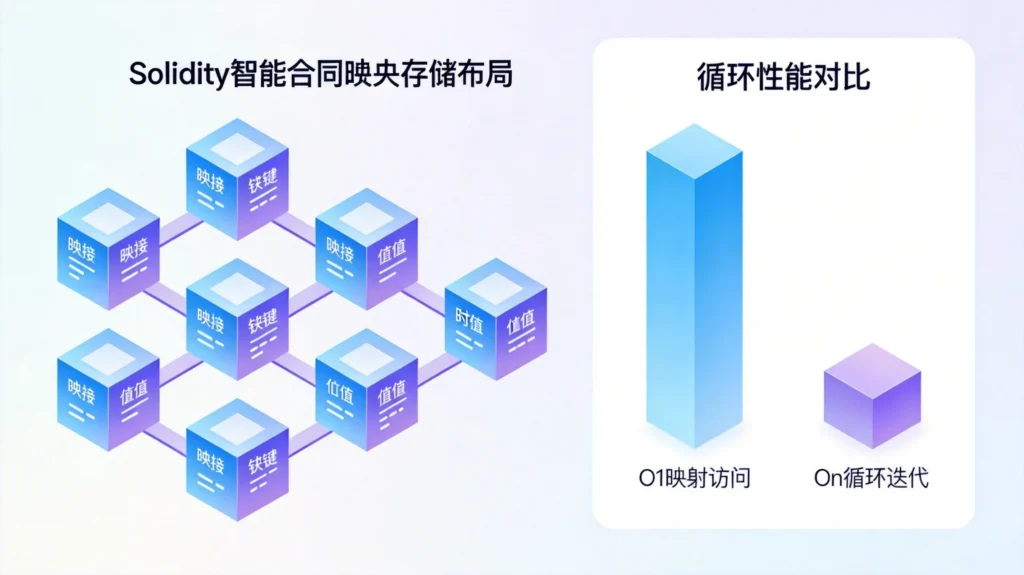
Solidity中的循环语句
Solidity支持三种循环语法:for循环、while循环和do-while循环。从Gas消耗角度看,它们几乎没有区别,但使用场景和代码可读性有所不同。
for循环的基础使用
for循环是最常用的循环结构,特别适合已知迭代次数的场景:
solidity
// SPDX-License-Identifier: MIT
pragma solidity ^0.8.24;

contract LoopExample {
    uint256[] public values;

    constructor() {
        values = [10, 20, 30, 40, 50];
    }

    // 计算数组总和
    function sumArray() public view returns (uint256) {
        uint256 total = 0;
        for (uint256 i = 0; i < values.length; i++) {
            total += values[i];
        }
        return total;
    }

    // 计算平均值
    function averageArray() public view returns (uint256) {
        if (values.length == 0) revert("Empty array");
        uint256 total = 0;
        for (uint256 i = 0; i < values.length; i++) {
            total += values[i];
        }
        return total / values.length;
    }
}
这个例子展示了for循环的基本用法。注意到我在循环外部声明了total变量,这是因为在Solidity中,内存变量和存储变量的Gas消耗差异巨大。每次修改存储变量都需要额外的Gas,而内存变量只在函数执行期间存在。
循环中的常见陷阱
循环中有一个很容易犯的错误:每次迭代都访问storage变量:
solidity
// 不推荐的写法:每次迭代都读取storage
function sumWithBadPractice() public view returns (uint256) {
    uint256 total = 0;
    for (uint256 i = 0; i < values.length; i++) {
        total += values[i]; // values[i]每次都从storage读取
    }
    return total;
}

// 推荐的写法:先加载到内存
function sumWithGoodPractice() public view returns (uint256) {
    uint256 total = 0;
    uint256[] memory vals = values; // 一次storage读取
    for (uint256 i = 0; i < vals.length; i++) {
        total += vals[i]; // 后续访问内存
    }
    return total;
}
在大型数组上,这两种写法的Gas差异会非常明显。storage读取的Cold访问费用大约是2100 Gas,而内存访问几乎可以忽略不计。
while循环的适用场景
while循环适合迭代次数不确定的情况,比如遍历链表结构:
solidity
contract LinkedListExample {
    struct Node {
        uint256 value;
        uint256 next; // 指向下一个节点的索引,0表示没有下一个
    }

    Node[] public nodes;
    uint256 public head; // 链表头节点索引

    constructor() {
        head = 0;
        nodes.push(Node({value: 0, next: 0})); // 创建虚拟头节点
    }

    function append(uint256 value) public {
        uint256 newIndex = nodes.length;
        nodes.push(Node({value: value, next: 0}));

        // 找到链表尾部
        uint256 current = head;
        while (nodes[current].next != 0) {
            current = nodes[current].next;
        }
        nodes[current].next = newIndex;
    }

    function traverse() public view returns (uint256[] memory) {
        uint256 count = 0;
        uint256 current = head;
        while (current != 0) {
            count++;
            current = nodes[current].next;
        }

        uint256[] memory result = new uint256[](count);
        current = head;
        uint256 index = 0;
        while (current != 0) {
            result[index] = nodes[current].value;
            current = nodes[current].next;
            index++;
        }
        return result;
    }
}
这个链表的例子展示了while循环在处理非线性结构时的优势。虽然它没有数组的随机访问能力,但插入操作的Gas消耗更低,因为不需要移动后面的元素。
映射mapping的底层机制
映射是Solidity中最常用的键值对数据结构。与传统编程语言不同,Solidity中的mapping是零初始化的,所有键都默认映射到零值。
mapping的基础语法
solidity
contract MappingBasics {
    // 基础映射
    mapping(address => uint256) public balances;

    // 嵌套映射
    mapping(address => mapping(address => uint256)) public allowances;

    // 复杂结构映射
    mapping(bytes32 => UserData) public userData;

    struct UserData {
        string name;
        uint256 registrationTime;
        bool isActive;
    }

    function setUser(address addr, string memory name) public {
        userData[keccak256(abi.encodePacked(addr))] = UserData({
            name: name,
            registrationTime: block.timestamp,
            isActive: true
        });
    }

    function getUser(address addr) public view returns (UserData memory) {
        return userData[keccak256(abi.encodePacked(addr))];
    }

    function approve(address spender, uint256 amount) public {
        allowances[msg.sender][spender] = amount;
    }

    function transfer(address from, address to, uint256 amount) public {
        require(allowances[from][msg.sender] >= amount, "Insufficient allowance");
        balances[from] -= amount;
        balances[to] += amount;
        allowances[from][msg.sender] -= amount;
    }
}
mapping的优势在于访问时间复杂度是O(1),无论映射中存储了多少数据,读取和写入的Gas消耗都是固定的。这是因为以太坊的存储模型本质上是键值对数据库,键的哈希值直接决定了值存储的位置。
理解mapping的存储布局
Solidity中的mapping并不直接存储在合约的数据区域,而是通过特殊的算法计算键对应的存储位置。要理解这个机制,需要看看Yul层面的实现:
solidity
contract StorageLayout {
    uint256 public singleValue;  // slot 0
    mapping(address => uint256) public addressToValue; // slot 1

    // 对应的存储布局:
    // singleValue存储在 slot 0
    // addressToValue[key] 存储在 keccak256(key . 1),其中1是addressToValue的slot编号
}
这个布局机制有几个重要含义:
- 无法直接遍历mapping – 没有办法枚举所有可能的键
- 读取是确定性的 – 给定键和slot位置,可以计算出存储位置
- Gas消耗稳定 – 无论mapping中有多少数据,单次读写成本固定
mapping的高级用法:反向索引
有时候我们需要根据值来查找键,比如根据用户名查找地址。这时可以维护一个反向索引:
solidity
contract ReverseIndex {
    // 地址到用户名
    mapping(address => string) public addressToUsername;

    // 用户名到地址(反向索引)
    mapping(string => address) public usernameToAddress;

    // 所有注册用户的列表
    address[] public allUsers;

    function register(string memory username) public {
        require(bytes(usernameToAddress[username]).length == 0, "Username taken");
        require(bytes(addressToUsername[msg.sender]).length == 0, "Already registered");

        addressToUsername[msg.sender] = username;
        usernameToAddress[username] = msg.sender;
        allUsers.push(msg.sender);
    }

    function findAddressByUsername(string memory username) public view returns (address) {
        return usernameToAddress[username];
    }

    function getAllUsers() public view returns (address[] memory) {
        return allUsers;
    }
}
这种设计虽然增加了写入时的Gas消耗(需要更新两个mapping),但查询效率非常高。在需要频繁查询的场景下,这种Trade-off是值得的。
循环与映射的性能优化技巧
现在进入实战环节,看看如何在实际项目中优化循环和映射的使用。
技巧一:缓存数组长度
每次在循环条件中访问array.length都会导致额外的操作:
solidity
contract LengthCaching {
    uint256[] public data;

    // 不推荐:每次比较都读取length
    function processBad(uint256 multiplier) public {
        for (uint256 i = 0; i < data.length; i++) {
            data[i] *= multiplier;
        }
    }

    // 推荐:缓存length
    function processGood(uint256 multiplier) public {
        uint256 length = data.length; // 缓存一次
        for (uint256 i = 0; i < length; i++) {
            data[i] *= multiplier;
        }
    }

    // 内存数组的最佳实践
    function processMemoryArray(uint256[] memory input) public pure returns (uint256[] memory) {
        uint256 length = input.length;
        uint256[] memory result = new uint256[](length);

        for (uint256 i = 0; i < length; i++) {
            result[i] = input[i] * 2;
        }
        return result;
    }
}
在storage数组上,这个优化带来的Gas节省可能不那么显著,因为EVM会缓存storage槽。但在memory数组和复杂的storage访问模式中,这个技巧能带来明显的性能提升。
技巧二:批量操作减少SSTORE
每个storage写入都需要消耗大量Gas。如果需要更新多个值,可以考虑合并操作:
solidity
contract BatchUpdate {
    struct User {
        uint256 balance;
        uint256 lastActivity;
        uint256 rewardPoints;
    }

    mapping(address => User) public users;

    // 逐个更新:每个用户3次storage写入
    function updateUsersOneByOne(address[] memory addresses, uint256 reward) public {
        for (uint256 i = 0; i < addresses.length; i++) {
            users[addresses[i]].balance += reward;
            users[addresses[i]].lastActivity = block.timestamp;
            users[addresses[i]].rewardPoints += reward / 10;
        }
    }

    // 批量更新:使用内存中转
    function updateUsersBatch(address[] memory addresses, uint256 reward) public {
        // 思路:在内存中构建完整数据,一次性写入
        // 但这需要权衡:内存操作复杂度 vs storage写入次数

        uint256 length = addresses.length;
        uint256 totalReward = reward * length;

        // 简化版本:减少频繁的状态读取
        for (uint256 i = 0; i < length; i++) {
            address user = addresses[i];
            User storage u = users[user];
            u.balance += reward;
            u.lastActivity = block.timestamp;
            u.rewardPoints += reward / 10;
        }
    }
}
真正有效的优化是减少storage访问次数而不是访问模式。EIP-2929之后,冷存储访问约2100 Gas,热存储访问约100 Gas。
技巧三:循环展开
对于已知小范围迭代,可以手动展开循环减少循环控制开销:
solidity
contract UnrolledLoop {
    uint256[8] public coefficients;

    // 普通循环
    function calculateNormal(uint256 x) public view returns (uint256) {
        uint256 result = 0;
        for (uint256 i = 0; i < coefficients.length; i++) {
            result += coefficients[i] * x;
        }
        return result;
    }

    // 循环展开(适合固定迭代次数)
    function calculateUnrolled(uint256 x) public view returns (uint256) {
        uint256[8] memory c = coefficients; // 缓存到内存
        return c[0] * x + c[1] * x + c[2] * x + c[3] * x +
               c[4] * x + c[5] * x + c[6] * x + c[7] * x;
    }
}
循环展开可以减少循环变量的递增和比较操作,但会增加代码体积。对于Gas敏感且迭代次数固定的场景,这个优化值得考虑。
技巧四:选择正确的数据结构
有时候,问题不在于循环和映射的使用方式,而在于整体数据结构的选择:
solidity
// 如果只需要添加和查询最后添加的元素
contract StackLike {
    struct Item {
        address owner;
        uint256 value;
    }

    Item[] public items; // 用数组而不是mapping

    function push(address owner, uint256 value) public {
        items.push(Item({owner: owner, value: value}));
    }

    // 查询最新项:O(1)复杂度
    function getLatest() public view returns (Item memory) {
        return items[items.length - 1];
    }

    // 如果业务允许,也可以用单项链表替代数组
}

// 用mapping模拟set(元素集合)
contract AddressSet {
    mapping(address => bool) public contains;
    address[] public list;

    function add(address addr) public {
        if (!contains[addr]) {
            contains[addr] = true;
            list.push(addr);
        }
    }

    function remove(address addr) public {
        if (contains[addr]) {
            contains[addr] = false;
            // 注意:这里没有从list中删除,只是标记不存在
        }
    }

    function size() public view returns (uint256) {
        return list.length;
    }

    // 获取所有有效元素
    function getAll() public view returns (address[] memory) {
        uint256 count = 0;
        for (uint256 i = 0; i < list.length; i++) {
            if (contains[list[i]]) {
                count++;
            }
        }

        address[] memory result = new address[](count);
        uint256 index = 0;
        for (uint256 i = 0; i < list.length; i++) {
            if (contains[list[i]]) {
                result[index] = list[i];
                index++;
            }
        }
        return result;
    }
}
这些数据结构示例展示了如何根据业务需求选择最合适的数据组织方式。有时候减少功能复杂度,反而能带来显著的性能提升。
实际案例:代币白名单系统
来看一个综合运用循环和映射的实例:
solidity
// SPDX-License-Identifier: MIT
pragma solidity ^0.8.24;

contract WhitelistSystem {
    struct WhitelistTier {
        uint256 maxAllocation;      // 该层级的最大额度
        uint256 currentAllocation;  // 已分配额度
        uint256 pricePerToken;      // 每代币价格
    }

    // 地址对应的层级
    mapping(address => uint256) public addressTier;

    // 各层级配置
    mapping(uint256 => WhitelistTier) public tiers;

    // 所有白名单地址
    address[] public whitelistedAddresses;
    mapping(address => bool) public isWhitelisted;

    // 层级计数
    uint256 public tierCount;

    event AddressWhitelisted(address indexed addr, uint256 tier);
    event TierConfigured(uint256 indexed tierId, uint256 maxAllocation);

    constructor() {
        _configureTier(0, 1 ether, 0.01 ether);   // 基础层:1 ETH额度
        _configureTier(1, 10 ether, 0.008 ether); // 高级层:10 ETH额度
        _configureTier(2, 100 ether, 0.005 ether); // VIP层:100 ETH额度
    }

    function _configureTier(uint256 tierId, uint256 maxAllocation, uint256 price) internal {
        tiers[tierId] = WhitelistTier({
            maxAllocation: maxAllocation,
            currentAllocation: 0,
            pricePerToken: price
        });
        tierCount = tierId + 1 > tierCount ? tierId + 1 : tierCount;
        emit TierConfigured(tierId, maxAllocation);
    }

    // 批量添加白名单地址
    function addToWhitelist(address[] memory addresses, uint256 tier) public {
        require(tier < tierCount, "Invalid tier");

        uint256 length = addresses.length;
        for (uint256 i = 0; i < length; i++) {
            address addr = addresses[i];
            if (!isWhitelisted[addr]) {
                addressTier[addr] = tier;
                isWhitelisted[addr] = true;
                whitelistedAddresses.push(addr);
                emit AddressWhitelisted(addr, tier);
            }
        }
    }

    // 查询某地址的可用额度
    function getAvailableAllocation(address addr) public view returns (uint256) {
        if (!isWhitelisted[addr]) return 0;

        uint256 tier = addressTier[addr];
        WhitelistTier memory tierInfo = tiers[tier];
        return tierInfo.maxAllocation - tierInfo.currentAllocation;
    }

    // 获取白名单统计
    function getWhitelistStats() public view returns (
        uint256 totalAddresses,
        uint256 tier0Count,
        uint256 tier1Count,
        uint256 tier2Count
    ) {
        totalAddresses = whitelistedAddresses.length;

        uint256 length = totalAddresses;
        for (uint256 i = 0; i < length; i++) {
            uint256 tier = addressTier[whitelistedAddresses[i]];
            if (tier == 0) tier0Count++;
            else if (tier == 1) tier1Count++;
            else tier2Count++;
        }
    }

    // 批量更新地址层级
    function updateTiers(address[] memory addresses, uint256[] memory newTiers) public {
        require(addresses.length == newTiers.length, "Length mismatch");

        uint256 length = addresses.length;
        for (uint256 i = 0; i < length; i++) {
            require(newTiers[i] < tierCount, "Invalid tier");
            addressTier[addresses[i]] = newTiers[i];
        }
    }
}
这个白名单系统展示了循环和映射在实际项目中的典型应用:批量操作、层级管理、统计查询。注意到我在循环中缓存了数组长度,并在每次迭代中只访问必要的字段,避免了不必要的重复读取。
总结
循环和映射是Solidity开发的基础构件,但它们的性能影响往往被低估。理解EVM的资源模型,选择合适的数据结构和循环模式,可以让合约的Gas消耗降低一个数量级。
关键要点回顾:
- 缓存循环中不变的值,减少重复读取
- mapping访问是O(1)的,但storage写入成本高
- 根据业务需求选择数据结构,而不是盲目使用复杂结构
- 批量操作可以摊销固定Gas成本
- 有时候简化业务逻辑比优化代码更有效
在实际项目中,建议先用简单直接的方式实现功能,然后通过测试和Gas报告来识别真正的性能瓶颈,再有针对性地进行优化。过度优化会增加代码复杂度,降低可维护性,这是另一种形式的成本。
相关资源
发表回复